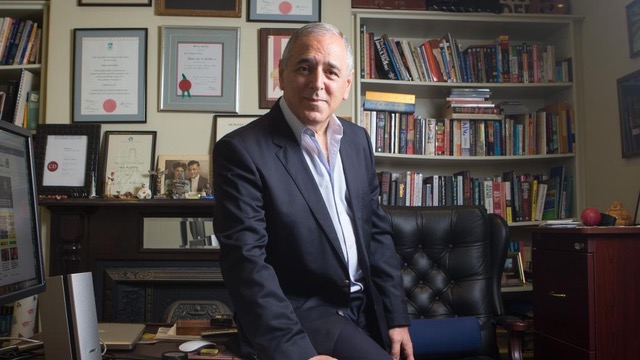
Former Director of Public Prosecutions in SA and WA, Stephen Pallaras KC, is calling for a specialist court to serve domestic violence cases only.
Mr Pallaras said the current domestic violence position in Australia was the result of, and reflected, two traditional attitudes towards this behaviour.
“The first is the husband is the head of the family and has the right to control what his wife says or does,” he said.
“The second is that whatever happens in someone else’s house is ‘nobody else’s business’. With the spiralling increase in serious acts of violence including murder, committed mainly against women by their male partners, the community has now no option but to face and then address this societal challenge.”
Mr Pallaras is advocating for a special domestic violence court because he argues there is one thing that typifies the magistrates courts, which is they are overcrowded and overburdened with work.
Domestic violence court cases are usually dealt with in the family court system, which was merged with the federal court circuit system a few years ago.
This merger has increased pressure on the court system and also increased delays in available court appearance availability.
Mr Pallaras said domestic violence in regional areas had additional issues needing urgent redress.
“The tyranny of distance may be a peaceful refuge for some, but to a woman in need of urgent help or protection, our regions are sadly lacking,” he said.
“Waving a restraining order in front of an enraged attacker rarely works, particularly if that attacker knows that it will take many hours for anyone to arrive to protect the victim.”
Mr Pallaras believed there were many manifestations of the tyranny of distance, but basically it all came back to a lack of resources and the time it took to get the resources to those in need.
There has been an increase of awareness of existing and new organisations focused on supporting and servicing the domestic violence crisis.
When asked how he observed these organisations were managing the current crisis, Mr Pallaras said the short answer was as best they could, given the levels of support they received from government.
“There is no doubting their good intentions and there is no doubting that they do excellent work where they can,” he said.
“However I believe that they have been limited in what they can do because of a hitherto common view that domestic violence is a ‘woman’s problem’.”
He said this view was simplistic in the extreme, and it was simply wrong.
“The problem is, by and large, caused by men and is essentially a ‘man’s problem’. Success in dealing with these issues will not come as long as this attitude prevails,” Mr Pallaras said.
In support of his advocacy for a special domestic violence court, Mr Pallaras added long delays were commonplace, if not the norm.
“This is not conducive to a jurisdiction that needs to be readily accessible, frequently in situations of urgency and stress,” he said.
“Victims of domestic violence ought to be able to access informed judicial intervention and assistance immediately and be dealt with by informed professionals who understand the exigencies of this area of the law.”
He also believed victims of domestic violence should be served by informed practitioners who knew more about it than what was published in newspapers because they had been specifically trained in this complex and difficult area.
The call for a special domestic court also extended to specialised departments and sections of the police, which was also stretched and limited in its training on handling domestic violence situations.
“I would advocate for a dedicated section of the police force, trained in all of the various aspects of these difficult conflicts,” Mr Pallaras said.
“This would result in an educated and therefore better response by police, and it would also greatly reduce the response time for those in need of assistance.”
The current police practice is to remove the victim, usually the woman and her children, from the scene of the violence rather than remove the perpetrator.
Mr Pallaras questions this and asks: “Why should the victim and any children have to reorganise their living conditions, if they can, rather than the perpetrator of the violence be required to do so?
“The common cry from some is that this will all take a lot of money. My reply? So what?”
Mr Pallaras was appointed Queen’s Counsel in 2000, appointed Senator for Life in International Association of Prosecutors, Committee Member International Association of Anti-Corruption Authorities and in 2012 appointed Judge of the High Court and Court of Appeal in Solomon Islands.
He continues his public advocacy for human rights.